Farm and agricultural restrooms in North Stamford run one portable toilet per 20 hand-labor workers, serviced within a quarter mile walk of the work area, under OSHA 1928.110. North Stamford Porta Pros sets up standard units, handwashing stations and holding tanks for farms, orchards and seasonal crews, with delivery scheduled around planting and harvest.
OSHA 1928.110 sets the baseline for hand-labor agricultural work: one toilet and handwashing facility per 20 employees, reachable within a quarter mile walk, plus potable water on site. That ratio holds whether you run a five-acre vegetable operation or a larger spread outside North Stamford proper. A standard porta potty rental covers most crews, and each unit carries a 60 to 70 gallon holding tank, enough for a full week of use under the ANSI/PSAI Z4.3 service baseline of one visit per week for up to 10 users over a 40 hour week. Bigger crews or longer harvest stretches need a tighter service interval, and we build that into the route before the first delivery truck shows up. If you are not sure how many units your acreage and headcount call for, the how many porta potties do I need guide walks through the math, and our porta potty placement guide covers where to stage them relative to field rows, packing sheds and equipment paths. Farms near the Norwalk line, about 10.8 miles east of North Stamford, face the same ratio requirement regardless of which side of that boundary the crew works. We also handle emergency porta potty rental when a unit gets knocked over by equipment mid-harvest, which happens more than you'd think on tight rows.
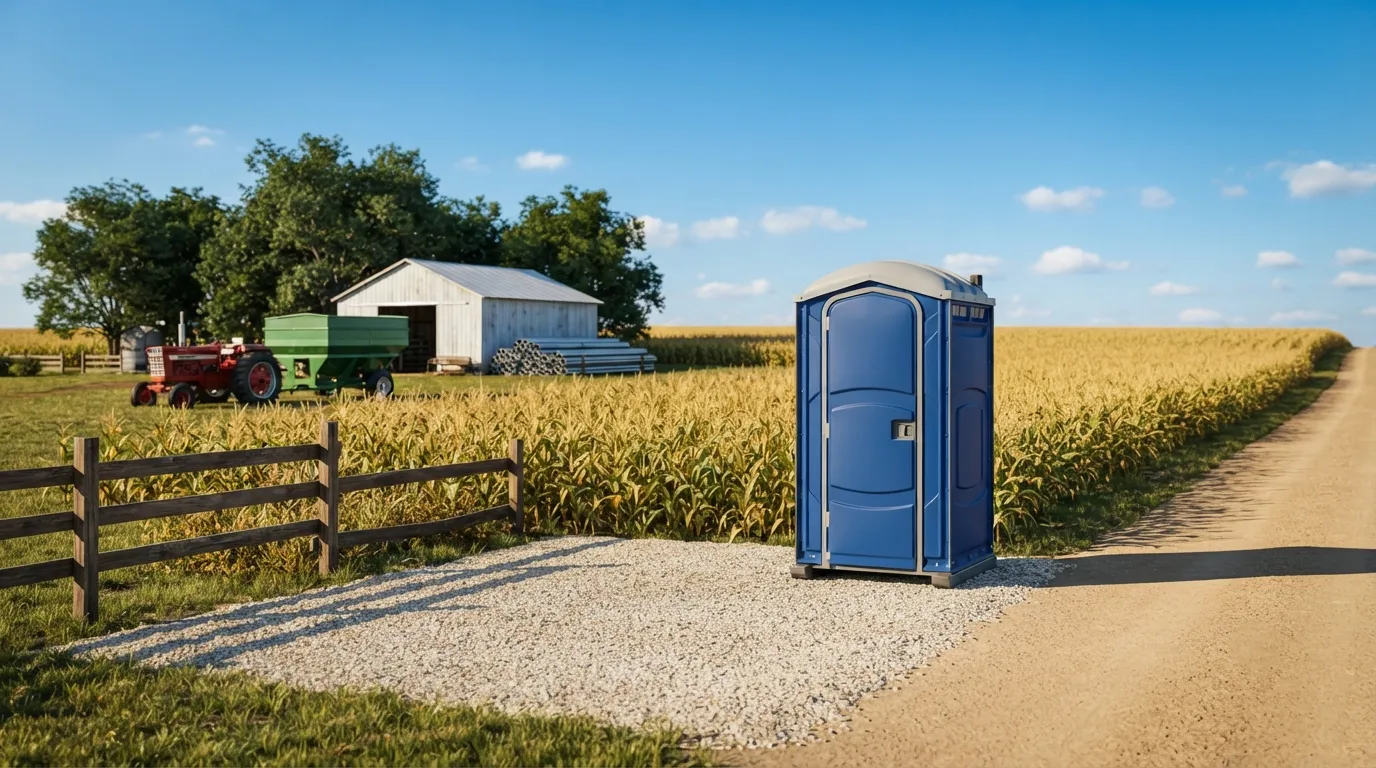
Standard units handle most field work, but some operations want more. A deluxe flushable porta potty suits farm stands and pick-your-own operations where paying customers use the same restrooms as staff. For larger operations running a packing crew plus field labor, a 2 stall restroom trailer or 4 stall restroom trailer cuts down on wait times during shift changes. Every cluster of portable units needs an accessible option too: ADA Standards section 213.2 requires at least 5 percent of clustered single-user units to be accessible, never fewer than one, with a 60 inch turning circle inside per ADA Standards section 304.3.1. Farms hosting agritourism, corn mazes or fall festivals in North Stamford should plan for that ADA unit alongside the standard fleet, not as an afterthought once the parking lot fills up. Handwashing is a separate requirement from toilets. OSHA 1928.110 calls for potable water and handwashing capability near the work area, and a handwashing station rental or portable sink rental satisfies that without asking workers to walk back to a farmhouse tap. If your crew handles pesticide or herbicide application, OSHA 1926.51(f)(1) requires washing facilities specifically for that contaminant exposure, separate from general field sanitation.
Yes, many North Stamford farms run a farmhouse septic system alongside portable field units, and the two need different service schedules. A residential septic tank is typically pumped every 3 to 5 years, driven by tank size and household size, and our septic pumping service covers that on a set rotation so it never becomes an emergency. Farms running a commercial kitchen, cider operation or food stand should also watch their grease interceptor: it needs pumping once fats, oils, grease and solids reach 25 percent of the liquid depth, which our grease trap pumping crew checks on each visit. For remote fields without existing plumbing, a holding tank rental gives seasonal workers a wastewater option that doesn't touch the main septic line at all. Watch for septic tank warning signs like slow drains or standing water near the tank, especially after a wet spring. If you're budgeting the full season, the septic tank pumping cost guide breaks down what drives the price up or down. Farms further out, like those closer to Fairfield roughly 21.5 miles northeast, still fall under the same pumping interval; distance from North Stamford doesn't change the tank chemistry.
| unit | duration | typical price |
|---|---|---|
| standard | month | $200 |
| standard | week | $200 |
| deluxe | week | $250 |
| septic | day | $250 |
Monthly rates make sense for a full growing season; see monthly porta potty rental for how that's structured, or compare it against the porta potty rental cost page if you're only running units for a single harvest week.
Weekly is the baseline under ANSI/PSAI Z4.3 for up to 10 users over a 40 hour week, but harvest crews often need twice-weekly visits. We build the schedule around your headcount and field hours, not a fixed calendar date, and adjust automatically if you add seasonal labor.
Yes, and we recommend a deluxe unit or small trailer for public-facing spots. Customers expect more than a field crew unit, and placement near parking keeps foot traffic away from active work areas. Check our porta potty placement guide first.
Once you're running more than a handful of standard units, a trailer often costs less hassle. An 8 stall restroom trailer suits large packing operations or festival-scale farm events with several dozen workers and visitors on site at once.
Placement rules can differ by parcel and road frontage, so confirm with the city before delivery day. See porta potty permit requirements for the questions to ask ahead of scheduling.
Yes. OSHA 1928.110 requires potable water and handwashing near the work area, distinct from toilet facilities. See handwashing requirements for how that gets set up alongside your standard units.
Yes. North Stamford Porta Pros delivers farm and agricultural restrooms across North Stamford and the surrounding metro, with same-day and next-day drop-off available on most orders.
Pricing depends on the unit and how long you need it. See our cost breakdown and request a free quote for an exact figure.
Standard rentals include scheduled service — a pump-out, a clean, a restock and fresh deodorizer. Busy or hot-weather sites can be serviced more often.
Call now or request a free quote — clean units, on-time delivery, transparent pricing.